Introducing a New Pet to Your Current Pets
How to introduce dog to dog, cat to cat, and dog to cat with scent swapping, controlled meetings, stress-sign reading, a realistic timeline, and what not to do.
An independent educational guide, not a veterinary consultation. Sources, illustrations & editorial standards
Bringing a new pet into a home that already has one is a delicate operation, not a casual meeting. Animals are territorial and social in ways that do not match our optimism. A rushed introduction can create fear or hostility that takes weeks to undo, while a slow, structured one often leads to calm coexistence or even friendship. The method depends on the pairing, but the principles are the same: go slow, control the meetings, and let the animals set the pace.
Start with scent, not sight
Before any face-to-face meeting, let the animals meet each other’s smell. Scent is how animals build a “who is this” map, and it is far less threatening than a sudden visual and physical encounter.
- Swap bedding or a soft cloth between the animals so each learns the other’s odor in its own safe space.
- Feed each animal on opposite sides of a closed door so the new smell is paired with something pleasant.
- Rotate which room each animal uses for short periods, so the resident pet encounters the newcomer’s scent in neutral territory.
- Watch for relaxed body language during these exchanges; curiosity is good, frozen stiffness is a signal to slow down.
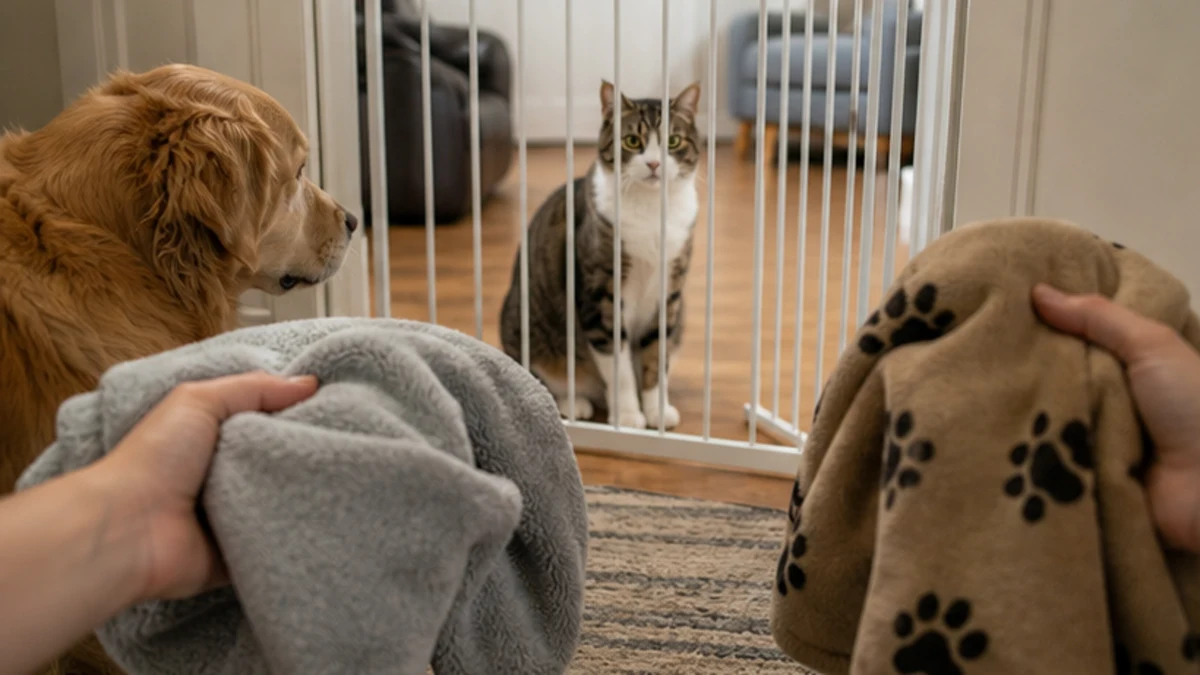
This phase can take several days. There is no prize for speed. The calmer the scent phase, the easier everything after it.
Dog meets dog
Dogs are social but status-conscious, and first meetings are about reading intent more than forcing friendship.
- Choose a neutral location such as a quiet street or park neither dog claims as its own.
- Use two calm handlers, each with a loose leash; tight leashes communicate tension, so keep slack.
- Let them sniff briefly, then walk them parallel at a distance, slowly closing the gap over several sessions.
- Reward calm behavior with treats and a soft voice; do not praise excited lunging.
- Separate at the first sign of stiff posture, hard stares, or raised hackles, and try again later.
At home, keep the newcomer gated in a separate room at first and let the resident dog investigate the scent. Only when both are calm through the barrier do you allow short, supervised together time. Build duration slowly.
Cat meets cat
Cats are more territorial than dogs and slower to accept a rival. Rushing a cat introduction is the fastest way to create a household where two cats merely tolerate each other, or worse, fight.
- Keep the new cat in its own room with food, water, litter, and a hiding spot.
- Swap scents daily using bedding or a sock rubbed on each cat’s cheek.
- Feed both cats near the door so the new smell joins a positive routine.
- Once calm through the door, use a baby gate or cracked door for visual contact, with an escape route for each.
- Allow short, supervised sessions with the new cat free and the resident cat able to leave. Never trap a cat with no exit.
Expect a longer timeline than with dogs. Some cats coexist within days; others need weeks. Progress is measured in calm indifference, not instant cuddling.
Dog meets cat
This pairing needs the most management, because the two species speak different body languages and a dog’s chase instinct can override training in the moment.
- Keep the cat in its safe room and let the dog learn the scent at the door first.
- Use a leash and a calm handler for the dog during every early meeting; the cat should have high ground or a clear exit.
- Reward the dog for ignoring the cat or looking at you instead of staring it down.
- Never let the dog “just say hi” off-leash until many calm sessions prove the cat is safe and the dog is uninterested in chasing.
- Watch the cat’s body: a flattened body, puffed tail, or hissing means stop and add more distance.
A dog that fixates, whines, and stares at a cat is not ready for freedom. A dog that glances and turns away is making progress. Let the cat set the comfort level; cats rarely lie about discomfort.
Reading stress signs
Learn the early warnings so you can intervene before trouble, not after.
- Dog stress: stiff posture, hard stare, raised hackles, frozen stillness, low growl, lip licking when no food is present.
- Cat stress: flattened ears, dilated pupils, puffed tail, crouching, hissing, or sudden stillness.
- Both: rapid panting without exercise, yawning when not tired, refusing treats they normally love.
These are communication, not disobedience. Respecting them is what keeps an introduction safe.
A realistic timeline
There is no fixed schedule, but a typical careful process looks like this:
- Days 1 to 3: full separation with scent swapping only.
- Days 3 to 7: feed near the barrier; brief visual contact through a gate.
- Week 2: short, supervised sessions in shared space with an exit available.
- Weeks 3 to 4: longer sessions, gradually less supervision, always reversible.
- Beyond: free coexistence if all meetings have been calm and no stress signs appeared.
Some pairs move faster; many move slower. If you feel pressure to “just let them work it out,” resist it. Unsupervised meetings before readiness are the main cause of lasting conflict.
What NOT to do
- Do not throw the animals together and hope they sort it out. They usually will not.
- Do not punish growling; it is a warning that buys you time to separate them.
- Do not force a shy animal to approach; pressure builds fear.
- Do not skip the scent phase to save time; it is the foundation.
- Do not leave them alone together until you are confident, regardless of how the last session looked.
- Do not let children manage the meetings; adults should run and end them.
Keeping the peace long term
A calm introduction is the start, not the finish. Long-term harmony depends on what happens after the animals share space. Keep resources separate so no one guards them: multiple food bowls spaced apart, one litter box per cat plus an extra, and several resting spots so the less confident animal is never trapped.
Feed pleasant moments together. Occasional shared treats at a distance, parallel play, and group downtime build positive associations without forcing closeness. Watch for quiet bullying, a dog that blocks a cat from the water, a cat that ambushes from a doorway, and interrupt it early by adding space or redirecting, not by scolding the victim. Most multi-pet homes reach a workable balance within weeks when the animals have room, resources, and a predictable routine. A few never become friends, and that is acceptable; peaceful coexistence is a success.
When to get help
If you see sustained aggression, injury, or a cat that stops eating or using the litter box out of fear, pause all meetings and contact a licensed veterinarian or a qualified behavior professional. Health issues can drive behavior changes, so a vet check for the newcomer is wise before you begin. A professional can also reshape an introduction that has already gone wrong, and earlier help works better than later.
Slow introductions feel tedious in the moment, but they are the difference between a home at peace and one under constant tension. Give the animals the time their instincts require, and most will reach at least calm acceptance, which is a perfectly good outcome.
PawPals provides educational content for new pet parents. We are not a veterinary practice, and this article is not a substitute for a veterinarian’s diagnosis or treatment. If your pet shows signs of illness, contact a licensed veterinarian.
Related reading
The First 30 Days With a New Pet: A Calm Adjustment Plan
A week-by-week plan for helping a new dog or cat settle in without overwhelming them, from safe rooms and routines to early vet records.
Read the guideThe First 48 Hours With Your New Dog or Cat
A calm, practical guide to your pet's first two days at home: the ride home, a quiet arrival space, the first meal, the first night, and your first vet visit checklist.
Read the guideA Pet-Sitter Handover That Leaves Less to Guess
Build a clear care sheet with feeding units, household rules, contact details and a practice handover. Includes a copyable template and a completed example.
Read the guideThis article is for education only and is not a substitute for a veterinarian's diagnosis. If your pet shows unusual symptoms, see a vet.