Teaching Sit, Stay, and Come
Use positive reinforcement and lure-reward training to teach sit, stay, and recall, with proofing steps and common mistakes to avoid.
An independent educational guide, not a veterinary consultation. Sources, illustrations & editorial standards
Three commands change daily life with a dog: sit, stay, and come. Sit politely asks for permission. Stay keeps him safe at a curb. Come can save his life if he bolts toward a road. The good news is that all three are easy to teach with treats and a happy voice, no force required. This guide covers the method that works for almost every dog: positive reinforcement with a lure-and-reward approach, short sessions, and slow “proofing” against real-world distractions.
Why positive reinforcement wins
Positive reinforcement means the dog gets something he likes for the behavior you want. The behavior grows because it pays. Compare that with punishment, which only tells the dog what not to do and can make him wary of you. A dog trained with rewards works with you because he wants to, not because he is afraid.
The tools you need are simple:
- High-value treats. Soft, smelly, and quick to swallow: small bits of chicken, cheese, or commercial training treats. Save the best for the hardest tasks.
- A calm voice. Your marker word, usually “yes” or “good,” tells the dog the exact moment he earned the treat.
- A treat pouch. So rewards are instant. Late rewards train the wrong thing.
- Patience. Sessions of two to five minutes, a few times a day, beat one long grim drill.
Sit with a lure
Sit is the easiest first lesson and the base for everything else.
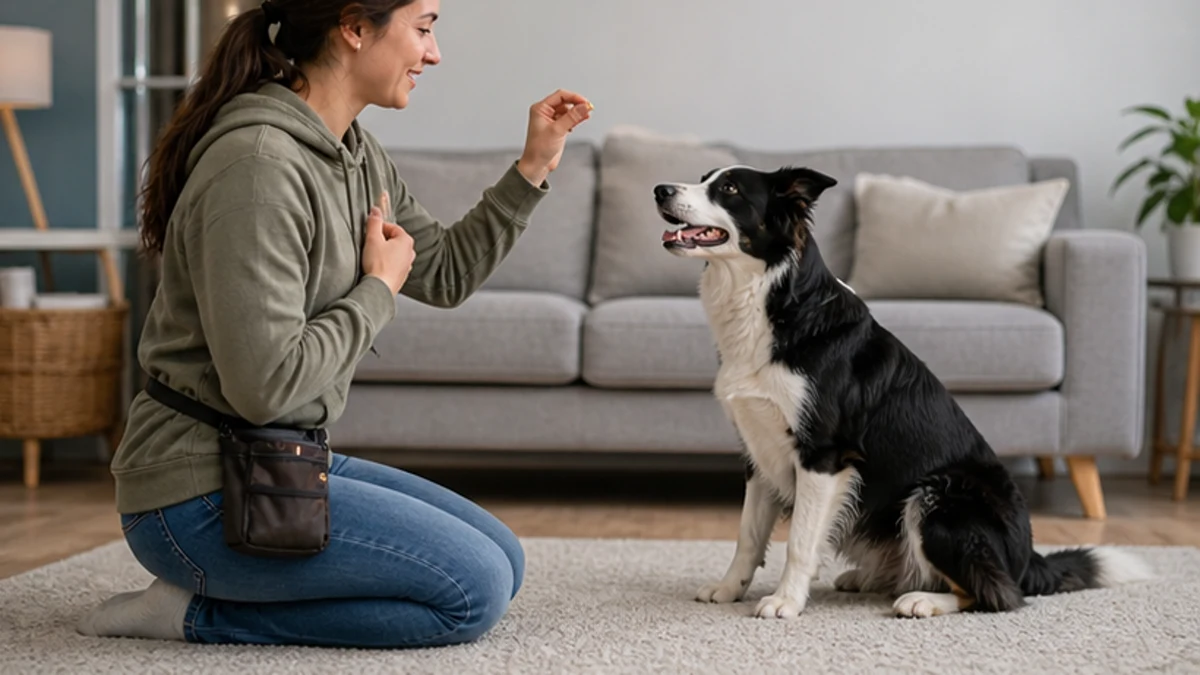
- Hold a treat at the dog’s nose, then slowly lift it over his head toward his tail.
- His nose follows up, his chin tips back, and his bottom drops. The moment his rear touches the floor, say “yes” and give the treat.
- Repeat several times, then add the word “sit” just before you move the treat. Soon the word predicts the lure.
- Fade the lure. Within a few sessions, show an empty hand in the same motion, say “sit,” and reward from the other hand when he sits. The hand signal becomes a word.
Trouble spots: if he jumps up, the treat is too high or moved too fast. Lower it and slow down. If he backs up, practice with his rear near a wall so backing is not an option. Keep it fun; end each session on a success.
Stay built in steps
Stay means “hold that position until I release you.” Teach it only after sit is solid, and build the three parts one at a time: duration, distance, and distraction.
- Duration. Ask for sit, say “stay,” and wait one second before “yes” and reward. Build to five, then ten, then thirty seconds over several sessions.
- Distance. With him sitting, take one step back, then return and reward. Increase to two, three, then across the room. Always return to him to reward at first, so he learns staying puts you back at his side.
- Distraction. Practice with a toy on the floor, then a helper walking past, then outside. Add only one new challenge at a time.
- Release word. Teach “okay” or “free” as the signal that stay is over. Without it, the dog guesses when to move, and stay falls apart.
A common error is asking for too much too soon: a thirty-second stay with you across the yard and a squirrel nearby, all on day one. That sets the dog up to fail. Stack the difficulty slowly.
Come, the most important recall
A reliable come is a safety command. Start where he cannot fail: indoors, on a long line, with zero competition.
- Say his name, then “come,” in a bright, happy voice, and crouch down with arms open.
- The instant he moves toward you, praise. When he reaches you, give a great treat and a big fuss.
- Practice from short distances, then longer, still on a leash or long line so he cannot practice running away.
- Never call him to something he dislikes. If “come” means the bath or the end of fun, he will learn to dodge you. Always make coming to you the best thing that happens.
- Add distractions last. Practice in the yard with a helper, then a quiet park on a long line, rewarding heavily.
The golden rule of recall: never punish a dog for coming, even if he took his time. If you scold when he finally arrives, he learns that coming leads to trouble, and next time he will not. Greet every return like a small celebration.
Proofing commands for the real world
A dog who sits in the kitchen may not sit at the park. “Proofing” means practicing the known command in harder places so it holds anywhere.
- Change the surface. Sit on grass, concrete, a wobbly mat.
- Change the position. You standing, you sitting, you across the room.
- Add movement. Ask for stay while you jog past.
- Add company. Other dogs, kids, noise, bikes.
- Vary the reward. Sometimes a treat, sometimes a toy, sometimes praise, so he never knows which and stays tuned in.
Move one variable at a time and drop back a step if he struggles. Proofing is not rushing; it is layering challenge so the behavior becomes default.
Common mistakes to avoid
- Repeating the cue. “Sit, sit, sit” teaches him that “sit” is a nag, not a command. Say it once. If he does not respond, reset and make it easier.
- Late or unclear reward. The treat must mark the exact behavior. A reward five seconds later trains whatever he did in between.
- Training when he is hungry for exercise, not food. A dog who has not eaten in hours works for kibble; a dog just fed may ignore it. Time sessions before meals.
- Too long, too dull. A tired, bored dog quits. Keep it short and end on a win.
- Inconsistent rules. If sit means sit for you but jumping is fine for a child, the dog is confused. Everyone in the home must use the same words and rules.
When to seek a trainer
Most owners can teach these three at home. But call in a qualified, reward-based trainer or a veterinary behaviorist if:
- Your dog shows fear, growling, or snapping during training.
- He ignores you completely even in calm settings after weeks of practice.
- You feel unsure or frustrated enough to consider harsh methods.
- The behavior problem is paired with anxiety, like separation distress.
Choose a trainer who uses food, toys, and praise, and who explains why a method works. Avoid anyone who leads with prong collars, shock, or dominance theory; modern evidence shows these harm the bond and can worsen problems. A good trainer coaches you as much as the dog.
A foundation you build together
Sit, stay, and come are not tricks to show off. They are the language you and your dog share, the calm that replaces chaos at the door, the safety at the street, the trust that grows with every treat. Teach them gently, practice them in the world, and keep the rewards real. In a few short weeks you will have a dog who looks to you for the next cue, and that attention is the start of every good behavior that follows.
PawPals provides educational content for new pet parents. We are not a veterinary practice, and this article is not a substitute for a veterinarian’s diagnosis or treatment. If your pet shows signs of illness, contact a licensed veterinarian.
Related reading
Puppy Biting and Nipping: Teaching Bite Inhibition
Understand why puppies mouth, use yelp-and-stop and toy redirection, manage overtired biting, and know normal vs concerning behavior.
Read the guideReading Your Dog's Body Language
Decode tail, ears, eyes, whale eye, play bows, stress yawns, and growls so you can respect your dog's boundaries and know when to back off.
Read the guideWhy Cats Scratch and How to Redirect It
Understand the natural need to scratch, choose and place the right posts, try nail care, and redirect furniture scratching without ever declawing.
Read the guideThis article is for education only and is not a substitute for a veterinarian's diagnosis. If your pet shows unusual symptoms, see a vet.