Why Cats Scratch and How to Redirect It
Understand the natural need to scratch, choose and place the right posts, try nail care, and redirect furniture scratching without ever declawing.
An independent educational guide, not a veterinary consultation. Sources, illustrations & editorial standards
If you share your home with a cat, scratching is not a question of if but where. A cat who scratches the sofa is not being destructive on purpose; he is doing something his body needs, in the only way he knows. The kind, effective answer is never to stop the behavior but to move it to a place you both like. This guide explains why cats scratch, how to pick posts they will actually use, where to put them, how nail care fits in, and why declawing is off the table for welfare reasons.
Scratching is natural, not naughty
Scratching serves several real needs, which is why you cannot simply train it away.
- Claw health. Scratching sheds the outer sheath of the claw, revealing the sharp, healthy nail underneath and keeps claws from overgrowing.
- Stretching. A good scratch stretches the muscles of the shoulders, back, and legs after a nap. Watch a cat drag down a post and you see a full-body yawn.
- Scent and scent marking. Cats have scent glands in their paws. Scratching leaves both a visible mark and a smell only another cat can fully read, marking the spot as theirs.
- Emotional release. Cats scratch when excited, when winding down, or when stressed. It is a pressure valve.
Because scratching meets these needs, the goal is redirection, not suppression. A cat who cannot scratch at all loses claw care, stretching, and a coping tool.
Choosing a post your cat will use
The market is full of posts, but many are ignored because they fail cat basics. A good post matches how cats like to scratch.
- Tall enough to stretch. A post should be at least as tall as your cat standing and reaching up. Short posts get shunned because he cannot get a full stretch.
- Stable, not wobbly. A post that tips when he leaps on it feels unsafe. Heavy base or wall-mounted is best.
- Texture he likes. Most cats prefer rough surfaces: sisal rope, sisal fabric, or corrugated cardboard. Many reject soft carpet because it feels like furniture and snags claws unpleasantly.
- Variety helps. Offer both a vertical post and a horizontal cardboard scratcher. Some cats are vertical scratchers, some horizontal.
- More than one. In a multi-cat or multi-room home, place several. One post in a far corner will be ignored.
Cardboard scratchers are cheap and beloved by many cats; replace them when worn. Sisal lasts longer. Having options lets the cat tell you his preference.
Placement is half the battle
Even a perfect post fails if it sits in a spare room nobody uses. Cats scratch where they are, and where the marking matters to them.
- Near the favorite nap spot. Cats scratch on waking, so a post by the bed or the sunny chair gets used.
- On the path to the action. A post in the living room traffic line is more tempting than one in a closet.
- At the marked furniture. If he loves the couch arm, put the post right next to it, then slowly slide it a few inches away over days once he uses it.
- At entry points. Cats often mark near doors and windows, so a post there matches instinct.
- At cat height. A post on the floor by a low window may beat a tall one in a dark hall.
Think like the cat: he scratches where he spends time and where he wants his scent. Put the post there.
Introducing the post
Do not just buy it and hope. Show him it is the best thing.
- Catnip or silvervine. Rub or spray a little on the post to draw interest. Not every cat responds, but many do.
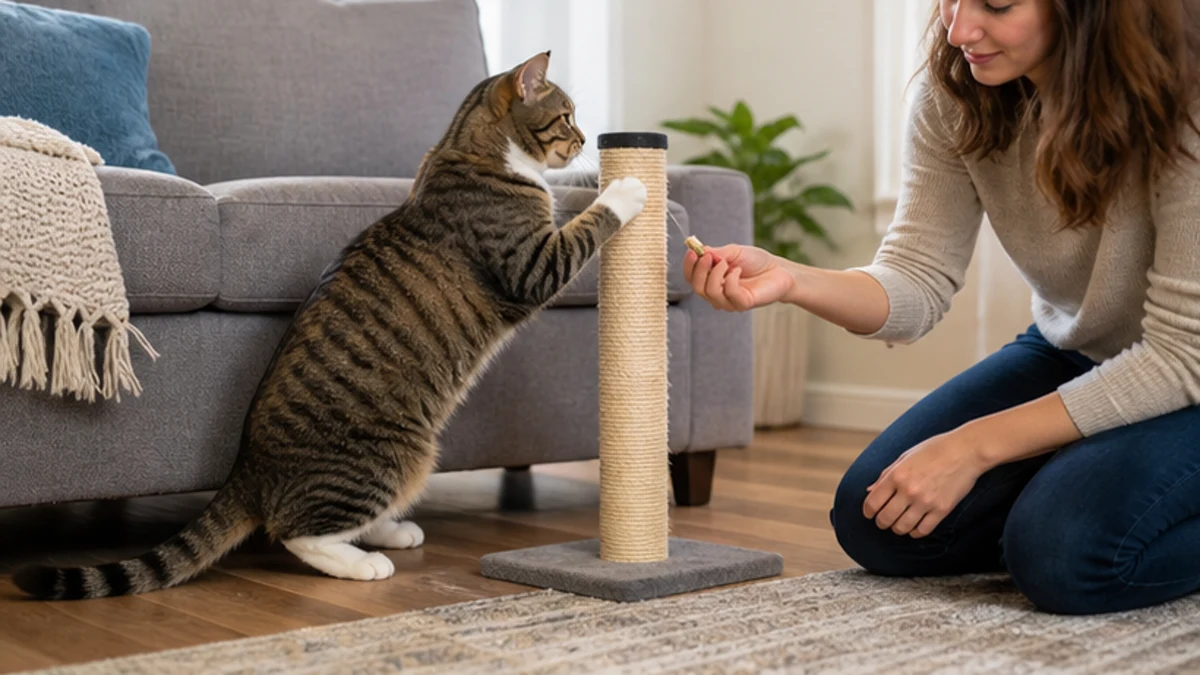
- Play near it. Dangle a toy up the post so his paws land on it as he swats.
- Reward use. The moment he scratches the post, calm praise or a treat. Mark the behavior he wants to repeat.
- Make it the exciting option. A new post placed in a social spot with a toy on top beats the old sofa by default.
Nail care: trimming and caps
Claw care reduces damage without stopping scratching.
- Trimming. A cat’s claws can be trimmed every two to three weeks with cat nail clippers, cutting only the clear tip and never the pink quick inside. If you are unsure, ask your vet or groomer to show you once. Start handling paws gently when he is relaxed so the routine stays calm.
- Nail caps. Soft vinyl caps glue over the claws and blunt them for several weeks. They do not stop the urge to scratch but protect furniture. They must be applied correctly and replaced as claws shed; some cats tolerate them, some do not. They are a management tool, not a fix for the behavior.
- Never declaw. Declawing is not a manicure. It is the surgical amputation of the last bone of each toe, like removing the tip of a finger at the joint. Major veterinary and welfare groups oppose it as elective surgery because it causes pain, changes how a cat walks, and can lead to lasting behavioral and physical problems. Many places have banned it. There is always a better route: redirect, manage, and protect.
Redirecting furniture scratching
When your cat loves the armchair, you redirect rather than scold.
- Block access briefly. Cover the spot with a washable throw or double-sided tape made for cats so it feels wrong under the paws.
- Offer the better target next to it. A post or cardboard scratcher right beside the furniture.
- Make the post rewarding. Catnip, play, and praise at the post; the furniture becomes boring and the post becomes fun.
- Move slowly. Once he uses the post, slide it an inch a day toward where you want it, over weeks, until it sits in a good spot he still uses.
- Clean the old spot. Use an enzymatic cleaner so the scent mark does not call him back.
If you catch him mid-scratch on furniture, calmly interrupt and lead him to the post; reward the post. Never yell or hit — that only builds fear and can trigger biting or hiding, and it does not teach him where to go.
Reading when stress is the cause
Some cats scratch more when anxious: a new pet, a move, a household change. Extra scratching at doors or windows can mean he feels threatened by something outside or insecure inside. In that case, more posts and vertical space help him feel in control, and reducing the stressor matters as much as the redirect. If scratching comes with other changes — not eating, hiding, aggression — a vet check rules out medical causes first.
A setup that works for life
A scratching cat is a healthy cat. Give him tall, stable, textured posts where he already wants to scratch, make them rewarding, protect the furniture in the meantime, and keep his claws trimmed or capped. Skip declawing entirely; it trades a cosmetic problem for a welfare one. With a little setup and patience, most cats happily shred the post and leave the sofa alone, and you keep both your furniture and a cat whose natural needs are met.
PawPals provides educational content for new pet parents. We are not a veterinary practice, and this article is not a substitute for a veterinarian’s diagnosis or treatment. If your pet shows signs of illness, contact a licensed veterinarian.
Related reading
Teaching Sit, Stay, and Come
Use positive reinforcement and lure-reward training to teach sit, stay, and recall, with proofing steps and common mistakes to avoid.
Read the guidePuppy Biting and Nipping: Teaching Bite Inhibition
Understand why puppies mouth, use yelp-and-stop and toy redirection, manage overtired biting, and know normal vs concerning behavior.
Read the guideReading Your Dog's Body Language
Decode tail, ears, eyes, whale eye, play bows, stress yawns, and growls so you can respect your dog's boundaries and know when to back off.
Read the guideThis article is for education only and is not a substitute for a veterinarian's diagnosis. If your pet shows unusual symptoms, see a vet.