Puppy Biting and Nipping: Teaching Bite Inhibition
Understand why puppies mouth, use yelp-and-stop and toy redirection, manage overtired biting, and know normal vs concerning behavior.
An independent educational guide, not a veterinary consultation. Sources, illustrations & editorial standards
Those needle-sharp puppy teeth hurt, and the constant mouthing can make a new owner wonder if they adopted a tiny shark. Take heart: biting is normal puppy behavior, and the phase passes. What you do now teaches “bite inhibition,” the single most important lesson a young dog learns about his own mouth. A dog who learns to control his bite as a puppy is far safer for life. This guide covers why puppies mouth, how to teach gentle jaws, what to do when he is overtired, and the line between normal nipping and something to worry about.
Why puppies mouth everything
A puppy explores the world with his mouth the way a human baby uses hands. Mouthing is how he learns texture, taste, and what is safe. On top of that, several forces drive the biting.
- Teething. Around three to six months, adult teeth push through sore gums, and chewing eases the ache.
- Play. With littermates, biting is how puppies play and learn limits. Without siblings, your hands become the substitute playmate.
- Attention. A puppy quickly learns that nipping gets a big reaction: a yelp, a pulled hand, a game of tug. Any response is attention.
- Overstimulation. Too much play, noise, or tiredness lowers his ability to be gentle.
Understanding the cause tells you the fix. You are not punishing a bad dog; you are teaching a skill he is still developing.
What bite inhibition actually means
Bite inhibition is a dog’s ability to control the force of his mouth. Puppies learn it with littermates: when one bites too hard, the other yelps and stops play. The biter learns “hard mouth ends the fun.” A dog with good inhibition may still mouth when startled but will not break skin, because he has practiced soft jaws his whole life.
The goal with a pet puppy is not to never use his mouth — that is unrealistic — but to teach that human skin is delicate and hard bites stop play. This lesson, learned young, prevents serious bites later.
The yelp-and-stop method
This mirrors what puppies do with each other and works with most dogs.
- When his teeth touch your skin with pressure, say a sharp, high “ouch” or yelp, then immediately stop interacting.
- Withdraw your hand and turn your body away for ten to twenty seconds. The fun ends the instant teeth touch skin.
- If he stays gentle or licks instead, you can resume calm play. If he bites again, repeat the yelp and pause.
- Keep it consistent across everyone in the home. If one person allows biting and another does not, the lesson never lands.
The yelp must be a reaction to the bite, not a threat. A loud, scary shout can frighten a soft puppy or amp up a rough one. Keep it a short, surprised “ouch,” then disengage. Over a week or two, you will notice his mouth softens.
If the yelp alone is not enough
Some puppies are so worked up that a single yelp does not register, or they come back biting harder. In that case, add a gentle “reverse time-out.” Stand up, fold your arms, and step away behind a baby gate, or simply turn your back for twenty to thirty seconds, removing all attention. The lesson is the same: teeth on skin ends the game completely. Return and resume only when he is calm. Never shout or shove him away roughly; the point is the loss of your attention, not a confrontation. Used consistently, this calm withdrawal teaches faster than any scolding, because puppies crave interaction and quickly learn that gentle play is the only way to keep it.
Redirect to a toy
Puppies need to chew; the task is to aim that need at the right thing.
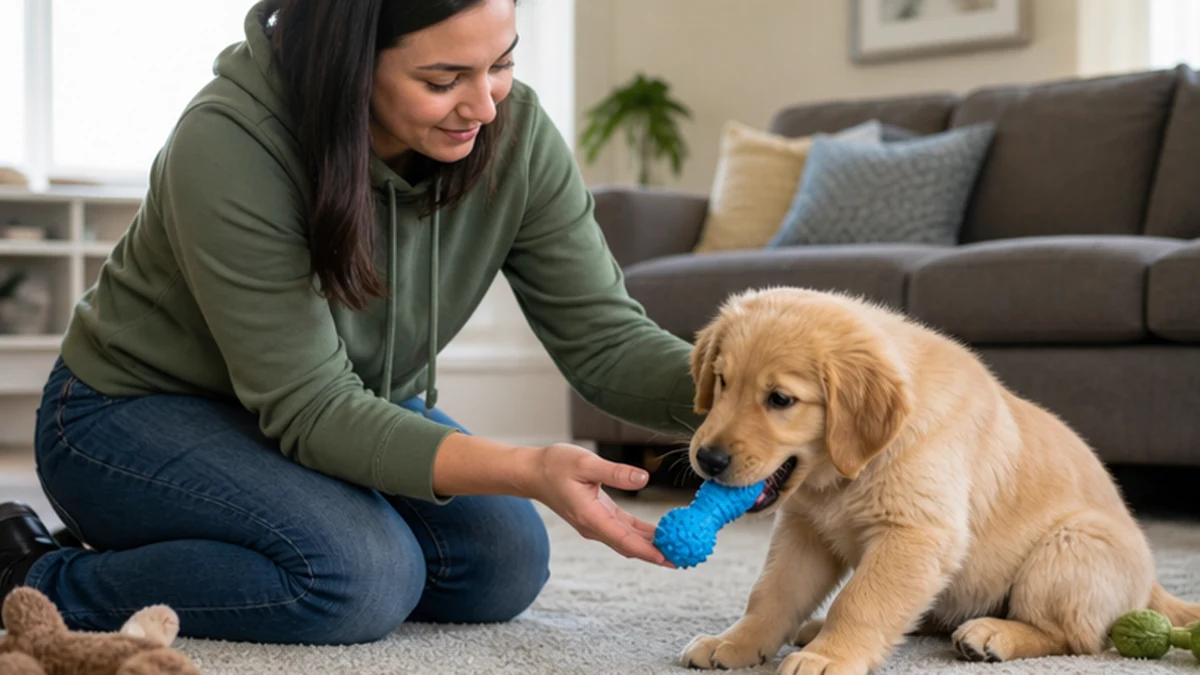
- Always have a toy ready. The moment teeth find skin, swap in a toy. “Teeth on skin means play stops; teeth on toy means play continues” is the message.
- Make the toy more fun. Wiggle it, drag it, make it alive. A boring toy loses to a moving hand every time.
- Offer a chew for teething. A chilled rubber chew or a frozen wet washcloth (knotted) soothes sore gums and gives a safe target.
- Reward the toy. When he chews the toy, praise and keep playing. He learns where the good feelings come from.
Handling the overtired bite
A huge share of “he bites constantly” complaints happen at the witching hour, often evening, when the puppy is exhausted but wired. An overtired puppy is like an overtired toddler: cranky, mouthy, and unable to settle.
- Read the signs. Zoomies, nipping fits, refusal to listen, and frantic energy often mean “I need sleep,” not “I need more play.”
- Enforce a nap. Put him in his crate or pen with a chew and let him crash. Most puppies need sixteen to twenty hours of sleep a day; owners often underestimate this.
- Use a forced calm-down. A food puzzle or a lick mat occupies the mouth and slows him, often tipping into sleep.
- Prevent the spiral. Cranky biting leads to more play, which makes him crankier. Break the loop with rest.
Many biting problems vanish once the puppy simply gets enough sleep.
Normal vs concerning
Most puppy mouthing is normal and fades by the time adult teeth settle, around six to seven months. But some signs mean you should get help rather than wait.
Normal includes:
- Mouthing during play that softens with the yelp method.
- Teething chewing on allowed items.
- Biting that stops when you redirect or end play.
Concerning includes:
- Biting with stiff body, growling, or hard stares, especially around food or toys.
- Breaking skin repeatedly despite consistent training.
- Bites that escalate in force over weeks instead of softening.
- Fear-based snapping at people or dogs without play context.
- Biting paired with resource guarding, like freezing over a bone.
These can signal a deeper issue — fear, guarding, or inadequate socialization — and are worth a reward-based trainer or veterinary behaviorist, not just home tips.
The role of socialization
Bite inhibition and socialization grow together in the same window, roughly the first three months. Safe, positive experiences with people, gentle handling, and other vaccinated puppies teach a dog that the world is okay and that mouths are for play, not defense.
- Handle gently and often. Touch paws, ears, mouth, and tail during calm moments with treats, so handling is normal, not a trigger.
- Pair people with good things. Let new visitors feed treats so strangers predict chicken, not fear.
- Puppy classes. Well-run classes with vaccinated pups build manners and bite control through play.
- Watch stress. Socialization is positive exposure, not flooding. A frightened puppy learns the wrong lesson.
What not to do
A few common reactions backfire badly.
- Hitting the muzzle or holding the mouth shut. This teaches fear or aggression and can escalate biting.
- Wrestling with hands. Using your hands as toys tells him hands are fair game to bite.
- Yelling constantly. A scared puppy may bite harder or learn to avoid you.
- Allowing it sometimes. Inconsistent rules confuse him and stretch the phase.
The payoff of patience
Teaching bite inhibition is uneven work. Some days he is gentle, some days he is a land shark, especially during teething peaks. Stay consistent: yelp and pause, redirect to toys, rest him when overtired, and keep socialization positive. By the time his adult teeth are in, a well-taught dog will mouth only softly and stop at a word. That control, built now, is what keeps every future interaction with children, guests, and vets safe.
PawPals provides educational content for new pet parents. We are not a veterinary practice, and this article is not a substitute for a veterinarian’s diagnosis or treatment. If your pet shows signs of illness, contact a licensed veterinarian.
Related reading
Teaching Sit, Stay, and Come
Use positive reinforcement and lure-reward training to teach sit, stay, and recall, with proofing steps and common mistakes to avoid.
Read the guideReading Your Dog's Body Language
Decode tail, ears, eyes, whale eye, play bows, stress yawns, and growls so you can respect your dog's boundaries and know when to back off.
Read the guideWhy Cats Scratch and How to Redirect It
Understand the natural need to scratch, choose and place the right posts, try nail care, and redirect furniture scratching without ever declawing.
Read the guideThis article is for education only and is not a substitute for a veterinarian's diagnosis. If your pet shows unusual symptoms, see a vet.