Crate Training Your Dog the Gentle Way
Turn a crate into a safe, happy den with positive crate training: choosing the right size, building good feelings, a step-by-step schedule, and fixes for whining.
An independent educational guide, not a veterinary consultation. Sources, illustrations & editorial standards
A crate can be one of the kindest things you give a dog. Dogs are den animals by ancestry, and a small, cozy enclosure often feels like a safe bedroom rather than a cage. The catch is that the crate only feels safe if your dog chooses it freely. When we force a dog inside or use the crate as a timeout, the dog learns to dread it, and the whole point is lost. This guide shows how to build a crate your dog walks into on his own, with a week-by-week plan and real fixes for the two most common problems: whining and refusal to settle.
Why a crate helps both of you
A well-loved crate is not a prison. It is a tool that keeps a dog safe and gives him a place the world cannot bother him. The benefits show up in everyday life.
- Safety when you cannot watch. Puppies chew wires, eat socks, and swallow things that need surgery. A crate keeps a curious mouth out of trouble for the twenty minutes you are in the shower.
- A calm retreat. Dogs, like people, sometimes want to be alone. A crate with the door open is a bedroom with a “do not disturb” sign.
- Easier travel and vet visits. A dog who loves his crate loads into a car or a clinic cage without panic, which lowers stress for everyone.
- Faster house training. Dogs rarely soil where they sleep. A crate teaches bladder control because the dog protects his own bed.
- Recovery after injury. If your dog ever needs rest after a procedure, a crate is a gentle way to limit jumping without constant confrontation.
The goal is never “lock the dog up for hours.” The goal is “give the dog a space he adores, and use it wisely.”
Choosing the right size
Size is the single biggest mistake new owners make. A crate should be big enough to stand, turn around, and stretch out, but not much bigger.
- Too big. If a dog can sleep in one corner and toilet in the other, the crate stops helping with house training. He will simply keep his bed clean and use the far end as a bathroom.
- Too small. A dog should never be cramped. He must be able to sit upright without hitting the top and lie on his side with legs extended.
- The divider trick. Most puppies grow fast. Buy the adult size and use the divider panel that comes with many wire crates. Move the divider forward as he grows so the space stays just right.
For a rough guide, measure your dog from nose to tail base while standing, then add about four inches. That length is your minimum crate floor. Height should clear the top of his head when seated. If you are between two sizes, the smaller one is usually the better training choice, with a divider for growth.
Setting it up for success
The crate should feel inviting from day one. Think of it as decorating a guest room, not storing a ladder.
- Location matters. Put the crate where family life happens: the living room or bedroom, not a cold basement or a lonely laundry room. A dog is a social animal and being cut off feeds anxiety.
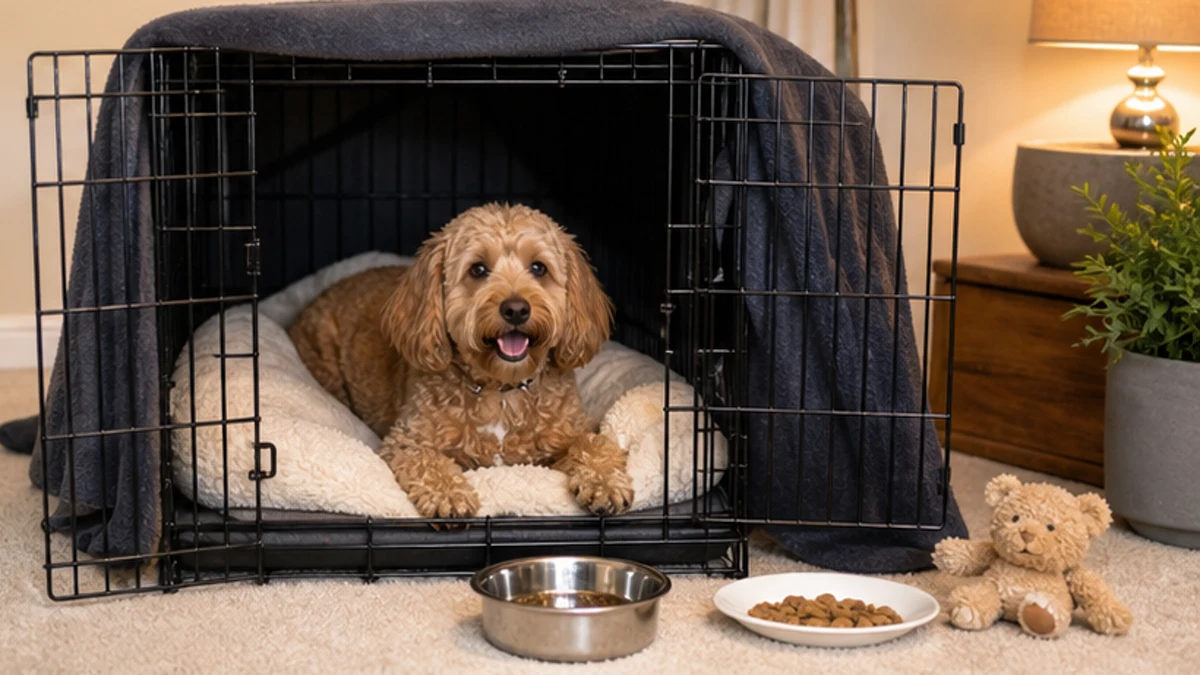
- Make it soft. A washable bed, a old T-shirt that smells like you, and a safe chew toy turn hard wire into a nest.
- Cover the top and sides. A light blanket over a wire crate (leaving the door clear and air flowing) creates the den feel dogs love.
- Feed meals inside. From the first day, put the food bowl in the crate with the door open. Eating in a place builds good feelings fast.
- Leave the door open often. A crate that is always shut looks like a trap. An open crate that is always available looks like a sofa.
Never use the crate for punishment. If you are angry and point at the crate, the dog links the crate with fear. The crate must mean only good things.
A gentle step-by-step schedule
Go at your dog’s pace, not a calendar’s. If he is happy on day three at a step, move on. If he is unsure, repeat the step. Rushing is the main reason crates fail.
Days 1 to 3: the crate is just a room
Toss a treat inside and let him walk in and out. Praise quietly when he goes in. Do not close the door yet. Feed at least one meal there. If he will not enter, place treats just outside, then closer, then inside, over several sessions. Never push him in.
Days 4 to 6: short closed sessions
Close the door while he eats, then open it before he finishes. Next, close the door for thirty seconds while you sit beside it, then release with calm praise. Build to one minute, then two. Drop a chew toy in so the door closing predicts something nice.
Days 7 to 10: you step away
Close the door and walk a few steps away, then return before he fusses. Slowly increase your distance and the time to two, then five minutes. Practice leaving the room for ten seconds and returning boring, no big greeting. The lesson is that you always come back and nothing scary happens.
Weeks 2 to 4: longer alone time
Build to thirty minutes, then an hour, always paired with a chew or a food toy. By now most dogs settle and even nap. Use the crate for real but limited absences, never all day. Adult dogs should not be crated far beyond a working day, and puppies need far more frequent breaks.
How long is too long
A crate is not a full-time home. Healthy adult dogs can usually hold their bladder for about one hour per month of age, up to roughly eight hours for a grown dog, but that is a limit, not a goal. Puppies under six months need a potty break every two to four hours. A dog left crated for ten or twelve hours daily is not trained; he is confined, and that causes his own behavior problems. If your schedule forces long alone time, consider a dog walker, a pet sitter, or a safe enclosed room instead of all-day crating.
Never use the crate as punishment
This point is worth repeating because it is the most common way crates get ruined. Saying “go to your crate” in an angry voice teaches the dog that the crate is where bad things happen. Instead, send him to the crate with a happy “go to bed” and a treat, so it stays a reward. If you are frustrated, take a breath and manage the dog another way: a leash, a baby gate, or a brief calm break for you. The crate stays pure positive.
Troubleshooting whining
Whining is the question every new owner asks. The answer depends on why he is whining.
- He needs to potty. Puppies have real small bladders. If he has been in longer than his limit, take him out quietly, no play, then back in. Do not scold; he is telling you something.
- He wants attention. If he is fed, watered, and recently pottied, whining is often a test. Wait for a pause, even two seconds of quiet, then reward the quiet with a calm “good” and maybe a treat through the bars. Rewarding quiet, not noise, teaches him that silence works.
- He is truly distressed. Constant, rising panic, drooling, or self-injury is not ordinary whining. That dog is not ready for the step you chose. Drop back to an easier step and go slower, and if it continues, talk with a trainer or your vet, because severe distress may need a tailored plan.
- You are reinforcing it by accident. Every time you open the door while he whines, he learns whining opens doors. Wait for calm, then open. This is hard but it is the fix.
A helpful trick is to watch for the moment he stops to listen or settles his head; mark that instant with praise so he knows exactly what earned the reward.
When the crate is not the right tool
Some dogs, especially those with a history of long confinement or strong anxiety, do not take to a crate easily. That is okay. A small gated room, a playpen, or a belt-and-braces management plan can work instead. The principle is the same: a safe space the dog chooses, built with patience. Forcing a terrified dog into a crate can deepen fear and is never the kind answer.
Building a lifetime habit
Once your dog loves the crate, keep it useful. Leave the door open so he can nap there by choice. Travel with it. Use it during parties when the noise is too much. A crate that stays positive is a gift that lasts the dog’s whole life: a portable bedroom, a calm corner, and a safety net all in one. Train it gently, respect his limits, and the crate becomes the place he goes to feel safe, not the place you put him when you are done.
PawPals provides educational content for new pet parents. We are not a veterinary practice, and this article is not a substitute for a veterinarian’s diagnosis or treatment. If your pet shows signs of illness, contact a licensed veterinarian.
Related reading
Teaching Sit, Stay, and Come
Use positive reinforcement and lure-reward training to teach sit, stay, and recall, with proofing steps and common mistakes to avoid.
Read the guidePuppy Biting and Nipping: Teaching Bite Inhibition
Understand why puppies mouth, use yelp-and-stop and toy redirection, manage overtired biting, and know normal vs concerning behavior.
Read the guideReading Your Dog's Body Language
Decode tail, ears, eyes, whale eye, play bows, stress yawns, and growls so you can respect your dog's boundaries and know when to back off.
Read the guideThis article is for education only and is not a substitute for a veterinarian's diagnosis. If your pet shows unusual symptoms, see a vet.