Cat Trees and Scratching Posts Explained
A practical, non-sponsored guide to why cats need vertical space, choosing height and stability, sisal vs carpet, placement, and multi-cat sizing.
An independent educational guide, not a veterinary consultation. Sources, illustrations & editorial standards
If you share your home with a cat, a cat tree is not a decorative extra — it is one of the most useful things you can buy. Cats are climbers and scratchers by biology, and a good tree gives them legal places to do both, sparing your sofa and your nerves. This guide explains why vertical space matters, how to judge height and stability, sisal versus carpet, where to put the tree, how to size for multiple cats, and how to introduce a wary cat to its new jungle gym.
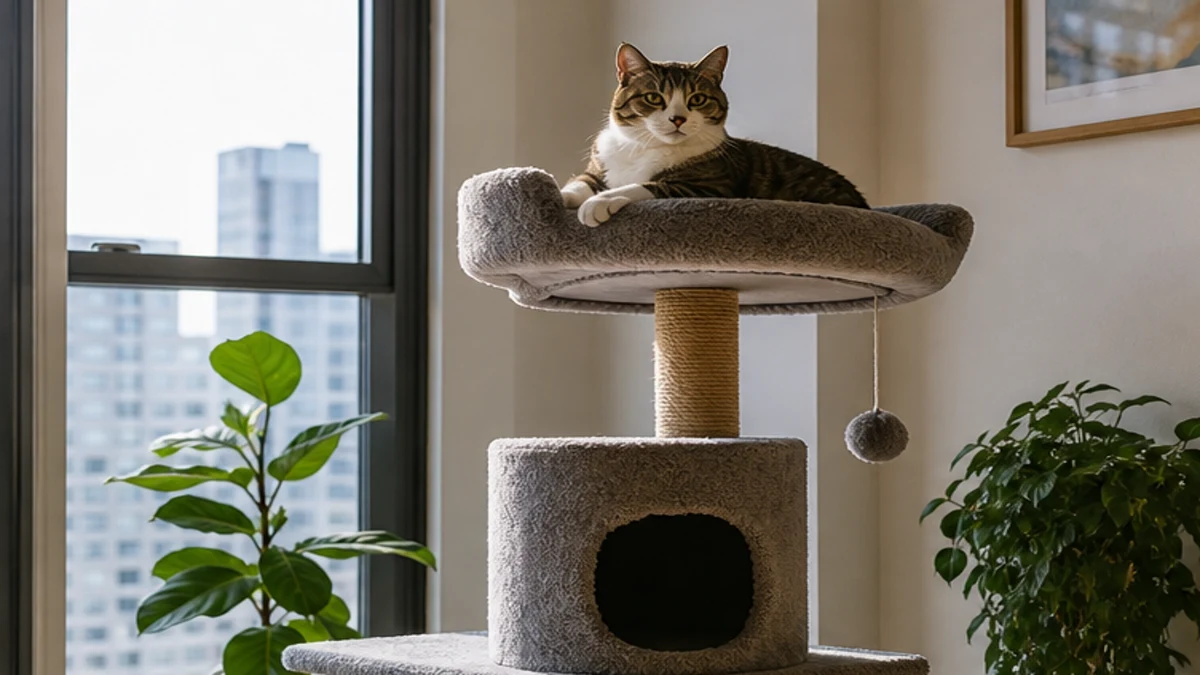
Why cats need to climb and scratch
Understanding the instinct makes the shopping easy. In the wild, cats patrol territory from high vantage points, watching for threats and prey. Your living-room cat retains that drive. A high perch is a stress reliever: from up there, the cat controls its view and escapes household chaos, dogs, or toddlers.
Scratching is equally hard-wired. Cats scratch to shed the outer sheath of their claws, to stretch their shoulders and back, and to leave both scent and visual marks that say “this is mine.” Deny them an acceptable surface and they will pick one you like less — the armchair. A cat tree that combines perches and scratching surfaces satisfies both needs in one structure.
Height and stability
The two specs that matter most are how tall the tree is and how solidly it stands.
Height
Taller is generally better for the view, but only if it is safe. A tall, wobbly tree is worse than a short sturdy one, because a cat that feels the structure shift under its paws will avoid it. For most homes, a tree with at least one perch at around eye-level-to-standing-human height is a good baseline, and many cats enjoy taller options that reach near a windowsill. Apartment dwellers with low ceilings should measure first.
Stability
This is where cheap trees fail. A cat launching onto a tippy tree can knock it — and itself — over. Look for:
- A wide, heavy base (solid wood or a broad particle board footprint beats a narrow post).
- A low center of gravity; multi-level trees should not topple if a cat jumps from the top.
- Wall-anchoring straps if the maker includes them, especially for very tall models.
- A lack of wobble when you push gently on the top platform in the store.
If a tree arrives and sways, either return it or anchor it to the wall before any cat uses it.
Sisal vs carpet
The scratching surfaces on most trees are covered in either sisal rope or carpet, and each has pros and cons.
Sisal rope
Sisal is the classic wound rope on posts. It gives a satisfying texture that most cats enjoy digging into, and it wears slowly. The downside is that as the rope frays, loose strands can catch a claw; you can trim these rather than replace the whole post. Sisal is the better default for dedicated scratching.
Carpet
Carpeted posts and platforms feel soft under paws and double as nap spots. The risk is confusion: if the tree is carpeted in the same tone as your living-room rug, a cat may decide the rug is fair game too. Carpet also shows stains and holds odor more than sisal. If you choose carpet, pick a color clearly different from your home carpet.
Cardboard and other surfaces
Some trees mix in cardboard scratchers or fabric loops. These are fine as extras, but the reliable workhorse is sisal. Offer at least one solid sisal post your cat can fully stretch against — the post should be tall enough that the cat’s body extends without the paws leaving the floor.
Placement near windows and routine
Cats are visual creatures, and a tree placed where they can watch birds, the street, or a garden turns dead time into entertainment. A perch by a window is cat television. Place the tree:
- Where your cat already likes to be, not in a forgotten corner.
- Near a window if possible, for the show outside.
- In a quiet-ish spot, but still part of family life — isolation makes the tree unused.
- Away from the litter box; cats do not relax where they eliminate.
- Stable on a flat floor, not on a rug edge that lets it rock.
If the only good window spot is sunny, great — many cats love a warm perch — but make sure the cat can retreat to shade when it gets too warm.
Sizing for multiple cats
In a multi-cat home, the tree needs to do more than serve one animal. Cats are territorial about height: the top perch is prime real estate, and a single top spot invites squabbles. For two or more cats, look for:
- Multiple distinct levels so each cat can claim its own tier.
- More than one high perch, so no one is forced to the bottom.
- Separate scratching posts, since cats often won’t share a post mid-session.
- Enough horizontal space that a cat can pass another without a face-off.
A good rule is one comfortable perch per cat plus one extra, mirroring the “n+1” thinking used for litter boxes. A bigger tree prevents a surprising amount of household tension.
Introducing the tree
Some cats leap on immediately; others need coaxing.
- Place the tree and let the cat investigate at its own pace; do not force it.
- Sprinkle a little catnip on a post or perch if your cat responds to it.
- Dangle a wand toy up the levels to invite climbing through play.
- Reward any exploration with calm praise or a treat.
- Put a familiar blanket on a platform to make it smell like home.
- Keep the tree near where the cat already rests, then move it gradually if needed.
If a post goes unused while the sofa gets attacked, try moving the tree nearer the sofa, or add a free-standing sisal post right where the cat scratches. Matching the surface to the cat’s preference is the key.
Common mistakes to avoid
A few patterns trip up first-time buyers. Buying the tallest tree regardless of stability produces a wobbly reject the cat avoids. Matching the carpet color to your rug teaches the cat the rug is fair game. Placing the tree in a lonely corner guarantees it goes unused. And assuming one small post serves two cats invites squabbles. Choose stability over height, contrast the color from your flooring, put the tree where the cat already likes to be, and size up for multiple cats.
A note on kittens and seniors
Kittens may need a shorter starter tree with easy steps, since a sheer vertical climb is beyond tiny legs. Seniors with arthritis may also struggle with tall climbs; choose a tree with gentle, frequent platforms and a low entry. The best tree is the one your specific cat will actually use.
PawPals provides educational content for new pet parents. We are not a veterinary practice, and this article is not a substitute for a veterinarian’s diagnosis or treatment. If your pet shows signs of illness, contact a licensed veterinarian.
Related reading
Pet Gear Worth Buying First on a Tight Budget
A priority list for new dog and cat owners: what protects safety and daily care first, and what can wait until later.
Read the guideChoosing a Carrier for Travel and Vet Visits
A practical, non-sponsored guide to hard vs soft carriers, sizing, ventilation, top-loading designs, acclimation, car safety, and airline rules.
Read the guideChoosing the Right Cat Litter and Litter Box
A practical, non-sponsored guide to litter types, box styles, the n+1 rule, placement, and daily cleaning routines.
Read the guideThis article is for education only and is not a substitute for a veterinarian's diagnosis. If your pet shows unusual symptoms, see a vet.