Choosing a Dog Leash, Collar, and Harness
A practical, non-sponsored guide to collars vs harnesses, leash materials, proper fit, and safe walks for puppies and adult dogs.
An independent educational guide, not a veterinary consultation. Sources, illustrations & editorial standards
A leash is not a fashion accessory for a dog — it is a safety line. The right combination of collar or harness and leash keeps your dog under control near traffic, prevents escapes, and protects their neck and trachea from injury. This guide covers flat collars, martingales, harnesses, leash materials, how to fit each piece, how to introduce a puppy to a harness, walking safety, and why ID tags and a microchip both matter.
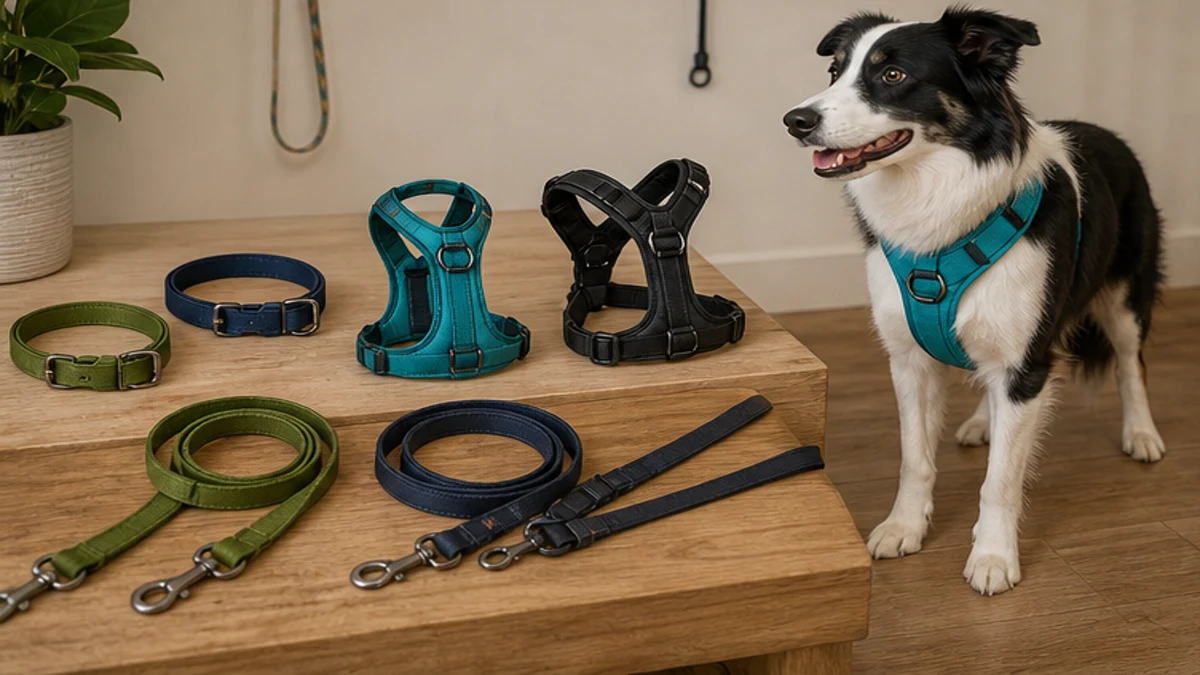
Collars and harnesses: what each does
Flat collar
A flat collar is the everyday basic: a strip of webbing or leather that buckles around the neck. It is ideal for holding ID tags and for dogs that walk calmly without pulling. For a dog that heels nicely at your side, a flat collar is often enough.
The limitation is pressure. When a dog lunges, all the force concentrates on the throat, which can strain the trachea and, in small breeds especially, cause a honking cough or worse. Never use a flat collar for a dog that pulls hard or for leash training a puppy.
Martingale collar
A martingale looks like a flat collar with a second loop. When the dog pulls, the loop tightens just enough to prevent slipping out, then stops — it cannot choke the way a chain choke collar can. Martingales are popular for sighthounds (whose heads are narrower than their necks) and for escape artists. They should be snug but never tight at rest, and they are a training aid rather than a forever collar.
Harness
A harness wraps around the chest and shoulders, spreading force across the body instead of the neck. For most dogs — especially puppies, small breeds, and pullers — a harness is the safer default. A well-designed front-clip harness can also gently discourage pulling by turning the dog back toward you when they lunge.
The trade-offs: a poor fit can rub the armpits, and a back-clip harness can actually encourage pulling in some dogs by giving them a “sled dog” leverage point. Fit and clip position matter more than brand.
Leash materials and types
Nylon
Nylon leashes are affordable, light, and easy to clean. They come in every color and length. The downside is that a suddenly pulling dog can burn your hand on thin nylon, and cheap clips can fail — choose a sturdy bolt snap.
Rope (biothane or climbing rope)
Rope leashes, including waterproof biothane, are durable and comfortable to hold. They are a favorite for active dogs and hikers. Biothane in particular wipes clean and does not hold odor.
Leather
Leather is classic, strong, and softens with use. It looks great and lasts for years if conditioned. It is heavier on the wallet and needs occasional care to avoid cracking.
Retractable leashes: pros and cons
Retractable leashes let a dog roam up to several meters on a thin cord inside a plastic handle. They feel convenient, but they have real risks: the cord can burn or cut skin, the lock can fail, the long reach keeps the dog far from you near hazards, and the handle is bulky if you need to grab quickly. Many trainers avoid them. If you use one, reserve it for quiet, open areas away from traffic and other dogs — never near roads or crowds.
Standard leash lengths
- Daily walks: a fixed 1.2–1.8 m (4–6 ft) leash gives control.
- Recall training or sniff time: a long line of 3–10 m (10–33 ft) in an open field, kept loose on the ground, not a retractable.
- Avoid tying a dog by the leash unattended — they can hang or tangle.
Getting the fit right
- Collar: you should fit two fingers between the collar and the neck. Too tight chafes; too loose slips off.
- Martingale: at rest it should sit loose; when tightened it should not slip over the head.
- Harness: measure the chest girth behind the front legs. Straps should be snug but allow a hand’s width; check the armpit area for rub after the first walks.
Always measure your dog before buying, and recheck fit every few weeks as puppies grow.
Introducing a puppy to a harness
Puppies often panic at the sensation of straps. Go slow:
- Let the puppy sniff and investigate the harness during play.
- Touch it to their body, then reward with a treat — no fastening yet.
- Slip it on for a few seconds, treat, and remove.
- Build to fastening, then a minute indoors, then a few steps.
- Only after they are comfortable indoors do you go outside.
Keep sessions short and positive. Forcing a squirming puppy teaches them the harness means stress.
Walking safety basics
- Practice “leave it” so a dropped chicken bone on the sidewalk is ignored.
- Keep the dog on your left or right consistently so they learn the pattern.
- Step off the path to let bikes, strollers, and nervous dogs pass.
- Carry water on long walks, especially in heat; pavement can burn paws — test with the back of your hand.
- Reflective gear and a light help at dusk.
ID tags and microchip
A collar with an ID tag is the fastest way for a finder to return your dog. But collars come off, which is why a microchip is essential: a rice-grain implant under the skin with a permanent ID, readable by any vet or shelter scanner. A microchip is only useful if the registry is kept up to date with your current phone number. Use both — the tag for speed, the chip as backup.
When a walk goes wrong
If your dog slips the collar or harness, stay calm and avoid chasing (that turns it into a game). Crouch, call happily, and show a treat. Preventing escapes starts with proper fit and rehearsing “come” at home.
Matching gear to your dog’s size and breed
Not every dog needs the same setup. Small dogs (under about 5 kg) are easily injured by collar pressure, so a well-fitted harness is the default; choose lightweight straps that do not overwhelm their small frame. Large and giant breeds need robust hardware — a weak clip is a genuine escape risk — and a front-clip harness helps manage pulling without choking. Brachycephalic breeds such as pugs and bulldogs should avoid collars entirely because their airways are already compromised; a harness protects their neck. Sighthounds (greyhounds, whippets) need martingales or harnesses because their narrow heads slip right out of a standard flat collar. Matching the gear to the dog is the first step toward safe, calm walks.
Loose-leash walking in practice
No piece of gear replaces training. Practice in a low-distraction space first: the moment the leash goes slack, mark and reward; the moment it tightens, stop and wait. Your dog learns that pulling gets nowhere and a loose leash earns progress. Keep treats at waist height to guide attention forward, and keep sessions short so neither of you gets frustrated. This approach is slower than buying a “no-pull” gadget, but the habit lasts a lifetime and strengthens your bond.
Caring for your gear
Inspect clips, stitching, and webbing monthly — a frayed leash can fail mid-walk at the worst moment, so replace it at the first sign of wear. Leather benefits from occasional conditioning to stay supple; nylon and biothane just need a wash with mild soap. Let buckles and clips dry fully before the next outing to avoid rust or stiff hardware. Good gear, looked after, lasts for years.
Travel and public spaces
On trips, pack a familiar leash and a spare in case one is lost. In busy areas, shorten the leash and keep your dog close; wide sidewalks and off-leash dog parks are not the place to test a new retractable. If your dog is nervous around strangers or other dogs, give them extra space and advocate for them — a polite “we’re in training” goes a long way. The leash is your tool for keeping everyone safe, including your dog.
PawPals provides educational content for new pet parents. We are not a veterinary practice and this article is not a substitute for a veterinarian’s diagnosis or treatment. If your pet shows signs of illness, contact a licensed veterinarian.
Related reading
Pet Gear Worth Buying First on a Tight Budget
A priority list for new dog and cat owners: what protects safety and daily care first, and what can wait until later.
Read the guideChoosing a Carrier for Travel and Vet Visits
A practical, non-sponsored guide to hard vs soft carriers, sizing, ventilation, top-loading designs, acclimation, car safety, and airline rules.
Read the guideCat Trees and Scratching Posts Explained
A practical, non-sponsored guide to why cats need vertical space, choosing height and stability, sisal vs carpet, placement, and multi-cat sizing.
Read the guideThis article is for education only and is not a substitute for a veterinarian's diagnosis. If your pet shows unusual symptoms, see a vet.