Safe vs Unsafe Toys for Pets
A practical, non-sponsored guide to toy materials, choking hazards, squeakers, rope and tennis-ball cautions, puzzle toys, rotation, and safe DIY options.
An independent educational guide, not a veterinary consultation. Sources, illustrations & editorial standards
Toys are not frivolous — they are how pets burn energy, practice instinct, and bond with you. But the pet toy aisle hides real hazards, and a “fun” toy can become an emergency if it is the wrong size or material. This guide covers what makes a toy safe, how to avoid choking and swallowing risks, the squeaker and rope debates, tennis-ball cautions, the value of puzzle toys, how to rotate a toy collection, safe DIY options, and a clear list of what to avoid.
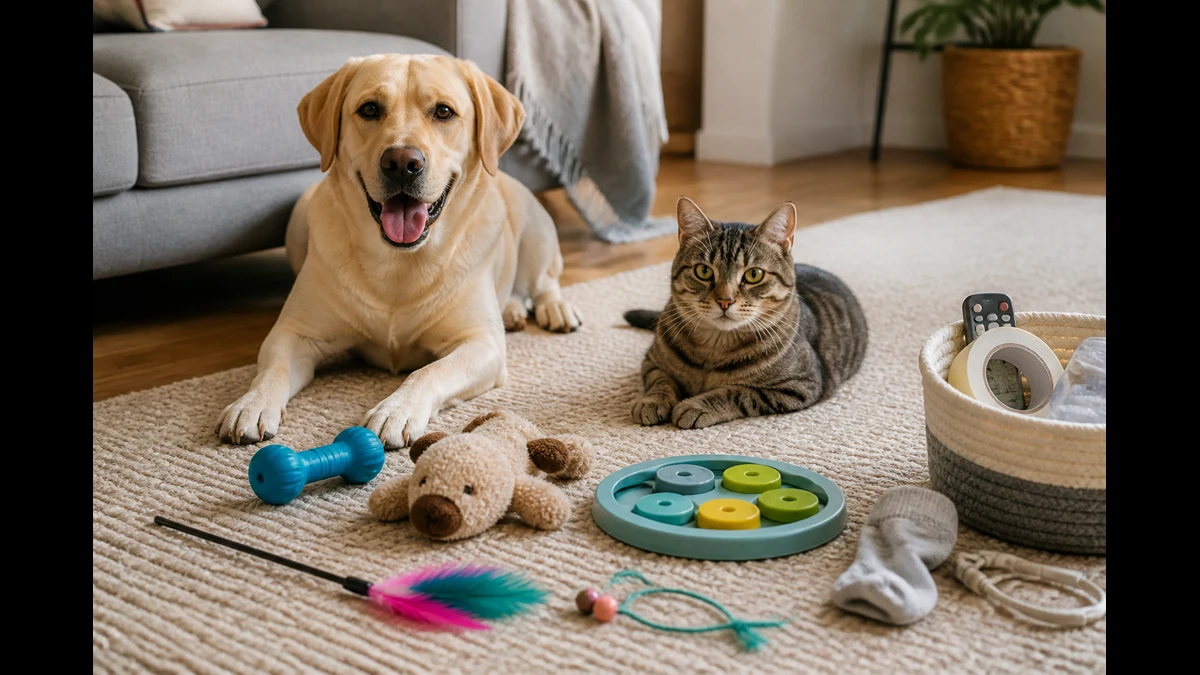
Material safety comes first
Start with what the toy is made of. Reputable pet toys use non-toxic dyes and materials tested for chewing, but the market is uneven, so shop from brands that state their safety standards and avoid mystery items from bargain bins.
- Soft plush: fine for gentle players, but a determined chewer can shred it and eat the stuffing or eyes.
- Rubber and nylon: durable for chewers; choose the right hardness for your pet’s bite strength.
- Natural fibers: rope and cotton are popular, with caveats covered below.
- Avoid anything with lead-based paint, strong chemical smell, or glued-on small parts you can pull off with light tugging.
When in doubt, the “fingernail test” for chew toys: if you can indent the surface with your fingernail, it is likely too soft for a powerful chewer; if it is rock-hard and could crack a tooth, it is too hard. Aim for something in between.
Size and choking hazards
The most common toy injury is swallowing something that blocks the gut. The rule is simple: a toy or its parts must be too big to swallow. For dogs, a ball should be larger than the dog’s mouth width so it cannot be gulped; for cats, avoid small balls or bells that could be inhaled.
Watch these specific risks:
- Toys with detachable eyes, noses, or bells that come loose.
- Squeakers that pop out once the toy is punctured.
- Latex pieces a small dog can bite off and swallow.
- Any toy small enough to fit entirely behind the pet’s back molars.
Supervise new toys for the first few play sessions, and retire any toy the moment it starts shedding pieces.
The squeaker question
Squeakers trigger a dog’s prey drive — that is why dogs love them — but a free squeaker is a choking and obstruction risk. Once a plush toy is torn, the squeaker often ends up on the floor, where a dog may swallow it.
Our guidance: squeaker toys are fine for supervised play with gentle chewers, but they are not safe as solo chew toys. If your dog disembowels plush toys, skip squeakers or only offer them during active play you control, then put them away. For cats, a soft silent toy is usually safer than a hard squeaker they might swallow.
Rope toys and tennis balls: handle with care
Rope toys
Rope is great for tug and gentle chew, but frayed rope is the problem. If a dog swallows string-like fibers, they can bunch inside the intestines — a serious, sometimes surgical condition. Use rope for interactive tug, not as an all-day chew. When the rope starts to unravel into strands, replace it. Never let a pet eat the fibers.
Tennis balls
Tennis balls are a classic, but they have two issues. First, the abrasive felt wears down tooth enamel over time, like fine sandpaper. Second, many dogs can compress a tennis ball enough to trap it at the back of the throat. Use tennis balls for fetch sessions you supervise, and choose a ball sized too large to swallow. For heavy chewers, a thicker rubber ball is safer on teeth.
Puzzle and enrichment toys
Puzzle toys — treat-dispensing balls, snuffle mats, lick mats — are among the best buys for mental health. They slow fast eaters, tire a bored dog, and give indoor cats a job. Start easy: a beginner puzzle that rewards effort quickly, then increase difficulty so the pet does not give up in frustration.
For cats, a simple cardboard box with treats hidden inside, or a ball-track toy, provides cheap enrichment. For dogs, a lick mat smeared with plain yogurt or pumpkin (vet-approved foods only) can soothe a stressed pup during a storm. Always supervise the first uses to be sure the pet can’t chew off and swallow parts.
Rotate, don’t hoard
Pets get bored with the same toy forever. A simple trick is rotation: keep a handful of toys out and store the rest, swapping the set every week or two. Toys that were ignored suddenly feel new, which stretches a small collection a long way and keeps interest high. Let your pet “win” occasionally by leaving an easy favorite available too.
Safe DIY options
You do not have to buy everything. Safe homemade enrichment includes:
- A toilet-paper tube with the ends folded, holding a few kibbles for a cat to bat open.
- A snuffle mat made from fleece strips tied into a rubber sink mat.
- A frozen lick mat for dogs on warm days.
- A crumpled paper ball for cats (supervised, no ribbons or tape).
- A clean sock knot for gentle tug with a puppy.
The rule for DIY: no small swallowable parts, no strings that could be eaten, and no items with food-safe-only concerns like cooked bones.
Reading the signs of a good toy
You can judge a toy by your pet’s behavior, not the packaging. A good toy holds attention without frustration, shows no damage after supervised sessions, and suits the mouth using it. A bad toy gets destroyed in minutes, is ignored after one sniff, or makes you nervous every time it is chewed. Trust those signals over marketing, and keep the toy’s condition part of your regular check — a toy is only safe while it is still intact, and its retirement is a sign of good care, not waste.
What to avoid entirely
A short, firm list of things that do not belong in a pet’s mouth:
- Cooked bones of any kind — they splinter and can pierce the gut.
- Rawhide that is poorly sourced or swallowed in chunks; it can cause blockages.
- Children’s toys with small parts, batteries, or toxic paint.
- Anything with a string, ribbon, or elastic the pet could ingest (cats and “string foreign bodies” are a real emergency).
- Gloves, socks, or underwear left within reach — laundry ingestion is common and dangerous.
- Magnets, coins, and small batteries, which are toxic if swallowed.
- Toys sized for a smaller pet given to a larger one.
Match the toy to the player
A senior cat wants a wand toy and a cozy chase, not a tug rope. A power-chewing Labrador needs durable rubber, not plush. A kitten needs size-appropriate, soft items. Read your individual animal: gentle players get plush and puzzles; strong chewers get tough rubber and supervision; all pets get rotation and your attention. The safest toy is one chosen for the mouth using it, watched during play, and retired the moment it breaks.
PawPals provides educational content for new pet parents. We are not a veterinary practice, and this article is not a substitute for a veterinarian’s diagnosis or treatment. If your pet shows signs of illness, contact a licensed veterinarian.
Related reading
Pet Gear Worth Buying First on a Tight Budget
A priority list for new dog and cat owners: what protects safety and daily care first, and what can wait until later.
Read the guideChoosing a Carrier for Travel and Vet Visits
A practical, non-sponsored guide to hard vs soft carriers, sizing, ventilation, top-loading designs, acclimation, car safety, and airline rules.
Read the guideCat Trees and Scratching Posts Explained
A practical, non-sponsored guide to why cats need vertical space, choosing height and stability, sisal vs carpet, placement, and multi-cat sizing.
Read the guideThis article is for education only and is not a substitute for a veterinarian's diagnosis. If your pet shows unusual symptoms, see a vet.